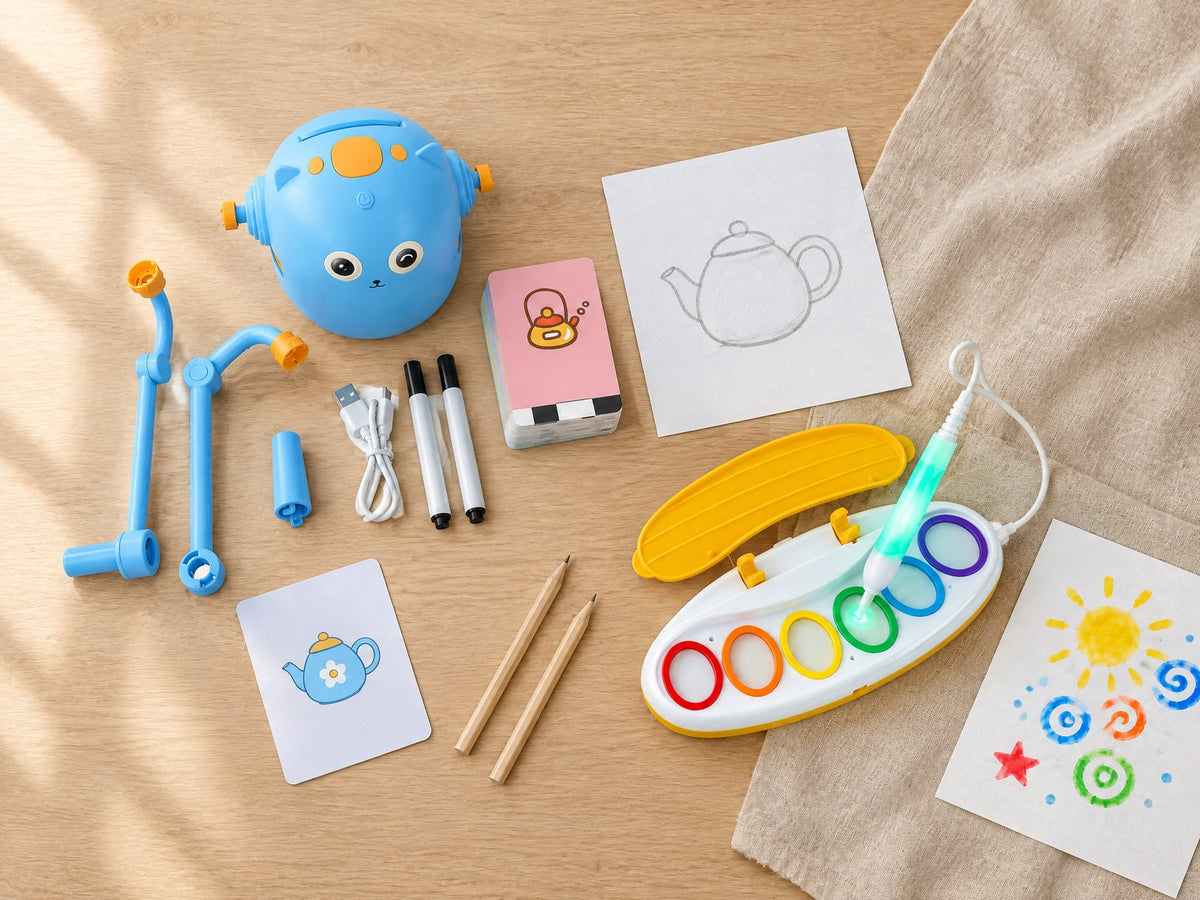
We keep our range small on purpose. Before anything goes on sale, it has to pass three questions, testing at home and a check of its safety papers. This page shows exactly how.
3
questions every toy must pass
5
steps from idea to our shop
30
days to return anything that isn't loved
The three questions
Duck asks the first, Pippin the second, and every parent we know asks the third.
01
Is it fun on day one?
If a child does not want to play with it straight out of the box, it does not make the cut. Instructions should take minutes, not an evening.
✓Ready to play within 10 minutes
✓Children ask for it again the next day
✓No app or account needed
02
Does it teach something?
Every toy has to build at least one real skill: pen control, colours, patience, building, curiosity about the world, or helping out at home.
✓Builds a skill you can name
✓Open-ended: more than one way to play
✓Grows with the child for months, not days
03
Will it last in a real family?
Little hands are tough on things. We look for toys that survive being dropped, packed away and found again, and that fit on a normal shelf.
✓Survives our drop and tidy-up test
✓Spare parts or refills where it matters
✓Packs away without taking over the room
From idea to our shop
Five steps every toy goes through. Most toys we look at stop somewhere along the way.
01Step 11
Spot a problem
We start with what parents tell us: rainy days, messy painting, too much screen time, bath-time tears.
02Step 22
Order samples
We order samples from several makers and compare build, materials and instructions side by side.
03Step 33
Test at home
Families we know play with the best ones at home. If interest fades after day three, it goes.
04Step 44
Check the paperwork
We ask for the CE declaration, EN 71 test reports and age grading before anything goes on sale.
05Step 55
List it honestly
Real photos, real measurements, the right age and what is in the box. No promises the toy cannot keep.
Our checklist
Play value
Fun from the first minute
Teaches a skill you can name
Works without a screen, app or subscription
More than one way to play
Something to show at the end: a drawing, a track, a meal
Safety and quality
We ask for the CE declaration and EN 71 test reports before we list a toy
Clear age guidance and warnings in your language
No small parts in toys for children under 3
Battery compartments closed with a screw where batteries are used
What we say no to
Saying no is most of the job. These never make it into our shop, however well they sell elsewhere.
These never make it into our shop, however well they sell elsewhere.
Toys that only work with an appIf the fun stops when the battery or the Wi-Fi does, it is not for us.
Loud one-trick electronicsButtons that make the same noise forever are fun for a day.
Anything without safety papersNo CE declaration and test reports, no listing. However good it looks.
Throwaway noveltiesIf it will be broken or forgotten in a week, we leave it on the shelf.
Product safety information
Every product page shows the age guidance and the safety warnings for that toy. If something about a product worries you, tell us straight away.
Some cookies keep the shop working, like your basket and checkout, so they are always on. With your OK we also use cookies to see which toys people like and to show our toys in ads on Meta, TikTok and Google.
You can change your mind any time under Cookie settings at the bottom of every page.Read our cookie policyCookie policy